







As a UK expat living in Canada, you may have substantial UK-based assets, including pensions, investments, and property.
You will need to manage these assets alongside wealth you have built in Canada – and without a plan in place, maintaining wealth across two jurisdictions may become stressful over time.
Rather than treating your UK and Canada-based assets separately, a joined-up approach helps to ensure your global wealth is working towards your wider financial goals.
Keep reading to discover why you need to audit your assets from day one, plus five steps you could take to secure your global wealth as a UK expat in Canada.
You need a clear understanding of your assets
It is easy to focus on individual accounts or investments in isolation, without considering how they fit together as part of your wider financial position.
For example, you may hold a range of investments with different levels of risk. Individually, they may seem appropriate. But when viewed as a whole, the overall portfolio may not reflect the level of risk you are comfortable taking.
The first step, therefore, is to understand exactly what you own, the values, and where those assets are based.
Once you have a clear view of your assets, here are five key steps you can take to build your coordinated global wealth strategy and achieve your wider financial goals.
1. Form an income strategy
Your retirement income could eventually come from several sources, including:
- UK-based private pensions
- The UK State Pension
- Canadian pensions
- Investments
- Property
It is important to understand how these different sources fit together and whether they are likely to provide the income you need, in the currencies you need it.
Coordinating these sources can make a significant difference to your overall financial plan. The timing of pension withdrawals, for example, could affect your taxable income. At the same time, the order in which different assets are drawn down may influence both investment growth and your tax position.
This is where cashflow modelling can be particularly valuable. Rather than looking at today’s pension and investment values in isolation, you can model how your global wealth might develop over time and how different income strategies could support your future spending needs.
Read our testimonials to find out how we have helped expats form an income from their global wealth.
2. Ensure your investments are working as a whole portfolio
Rather than assessing each investment account separately, you should consider your overall portfolio when managing issues such as diversification, risk, and your investment objectives.
For example, you might hold similar equity investments through a UK pension and Canadian investment accounts without realising that your overall portfolio is more concentrated than it appears.
Equally, you might have too much money sitting in cash because you are uncertain about what to do with assets retained in the UK.
Our financial advisers can help you assess your investments and create a plan that suits your risk tolerance and long-term objectives.
3. Think about currency risk
Though you may be drawing from a UK pension, your retirement spending will primarily be in Canadian dollars. Movements between sterling and the Canadian dollar can affect the value of that pension when measured against your future spending needs.
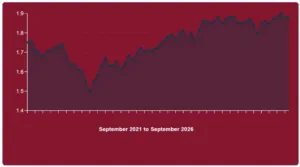
Here’s the sterling-to-Canadian-dollar exchange rate over the last five years.
Source: Google
The type of spread over that period of $1.49 to $1.88 – a 25% differential – will affect your purchasing power and could mean you have to cash in more UK-based investments at certain times to provide the same level of Canadian income.
However, this does not automatically mean you should convert everything into Canadian dollars immediately.
Some currency diversification can help, particularly if you expect future spending in both countries. So, you should focus on matching the currencies of your assets and income to your future spending needs, rather than trying to predict currency movements.
4. Don’t let tax drive your whole strategy
Your global wealth plan needs to account for where and how your different assets and income sources are taxed.
However, it is important not to allow tax considerations to dictate your overall strategy.
Tax efficiency obviously matters, but it should not become the overriding factor in every financial decision you make. The most tax-efficient option is not necessarily the one that best supports your financial objectives or long-term plans.
The aim should be to understand the tax implications of your decisions and incorporate them into a wider financial strategy – rather than allowing tax considerations to dictate the strategy itself.
Read more: The UK-Canada Double Tax Treaty explained
5. Consider how you will pass cross-border assets down to the next generation
Estate planning becomes particularly important when you have assets, family, and financial connections in two or more countries.
Your estate is likely to include UK pensions, property, and investments alongside Canadian assets, which means you are dealing with two different tax jurisdictions. As a result, the tax treatment of your assets can depend on their type and location, and the rules in force at the time.
It may also be advisable to have separate wills covering your assets in each country. These can be drafted to work alongside each other, helping ensure local legal requirements are met, and your estate can be administered as efficiently as possible.
As with the other aspects of cross-border financial planning you have read about, you should review your estate plan regularly. Changes in your circumstances and tax legislation can affect whether your existing arrangements remain appropriate.
Get in touch
Specialist financial advice can add real value to your global wealth decision-making.
Working with an adviser who understands both the UK and Canadian systems can help you view your wealth as one overall strategy, rather than a collection of separate assets and accounts.
If you would like to discuss your financial planning arrangements with a member of our team, email info@abg.net or call +1 905-286-5894 to speak to an adviser.
Please note
This article is for information only; it does not take into account your personal objectives, financial situation, or needs.
Please do not solely rely on anything you have read in this article and ensure that you conduct your own research to ensure any actions you may take are suitable for your circumstances.
All content is based on our understanding of HMRC and Canada Revenue Agency legislation, which is subject to change.
A UK personal pension is a long-term investment not normally accessible until 55 (57 from April 2028). The fund value may fluctuate and can go down, which may affect the level of pension benefits available. Past performance is not a reliable indicator of future performance.
The tax implications of pension withdrawals will be based on your individual circumstances and the jurisdiction of the country in which you live. Thresholds, percentage rates, and tax legislation may change in subsequent Finance Acts.
Get tips, updates, and expert insights
Join our newsletter today.